Army AFT & ACFT Score Calculator (2026)
Check per-event points, total score, and pass/fail for AFT (2025+) or ACFT (Legacy) by age band, sex, and MOS standard.
Overview
Trying to figure out whether your current 2-mile run or SDC time clears the 60-point minimum—and how much you actually need to improve—often comes down to one detail: AFT/ACFT scoring is threshold-based, not “smooth” or proportional.
Use this page to plan realistically: pick AFT (2025+) or ACFT (Legacy), then interpret your results with the same logic used in the official step tables. If you want the broader context, start at the Health & Fitness hub.
Last Verified: December 2025
What changes your outcome (and what doesn’t)
- Changes your score: crossing a cutoff row (example: improving SDC from 2:07 to 2:06 can matter, while 2:07 to 2:06:5 cannot).
- Changes your pass/fail: dropping below 60 points on any single event—even with a strong total.
- Usually doesn’t change your points: small improvements that stay inside the same cutoff band.
Quick navigation: worked examples • visual guide • FAQ
Formula & Methodology
The scoring method is simple, but it behaves differently from “percent better” thinking: each event is matched to a step table and the tool awards the best point row you qualify for.
| Event | Direction | Typical unit | Common scoring pitfall (logic) |
|---|---|---|---|
| 3RM Deadlift | Higher is better | lb / kg | Entering per-side plates instead of total load. |
| Hand-Release Push-ups | Higher is better | reps | Counting “almost reps” that won’t be credited under strict standards. |
| Sprint-Drag-Carry | Lower is better | mm:ss | Assuming “a little faster” always adds points (it doesn’t unless you cross a cutoff). |
| Plank | Higher is better | mm:ss | Mixing formats: 210 means 2:10 here, not 210 seconds. |
| 2-Mile Run | Lower is better | mm:ss | Rounding your pace conversion and landing just below a cutoff time. |
| Standing Power Throw (ACFT) | Higher is better | m / ft | Using an average throw instead of the best legal attempt. |
points(event) = best point row that you satisfy


Higher-is-better (MDL, HRPU, Plank, SPT):
choose the highest row where raw ≥ threshold

Lower-is-better (SDC, 2-Mile Run):
choose the highest row where time ≤ threshold

total = sum of event points
pass = (every event ≥ 60) AND (total ≥ minimum total)
Pass rules (the part most people miss)
| Standard | Minimum per event | Minimum total | Interpretation |
|---|---|---|---|
| General | 60 points | 300 points | All five events must be ≥60; totals don’t “save” a failed event. |
| Combat MOS | 60 points | 350 points | Same per-event rule; higher total target. Pass line is sex-neutral, still age-banded. |
Quick Reference: 27–31 cutoffs you can plan around
If you’re in the default band (27–31), these are the exact 60-point (pass line) and 70-point thresholds shown in the tables below for AFT. Other age bands differ—always set the correct band before interpreting.
| Event | 60 points (M) | 70 points (M) | 60 points (F) | 70 points (F) |
|---|---|---|---|---|
| 3RM Deadlift (lb) | 150 | 190 | 120 | 140 |
| HR Push-ups (reps) | 14 | 26 | 11 | 16 |
| SDC (max time) | 2:32 | 2:06 | 3:15 | 2:43 |
| Plank (min time) | 1:20 | 1:52 | 1:20 | 1:52 |
| 2-Mile Run (max time) | 19:45 | 18:23 | 22:45 | 21:00 |
For the full at-a-glance tables (all age bands), jump to the tables section.
Worked Examples (real numbers + short interpretation)
Example 1: “Exactly pass” General at 300 (27–31)
Goal: clear the minimum with no extra margin.
- Profile: AFT • 27–31 • Standard: General
- Inputs (Male): MDL 150 lb • HRPU 14 • SDC 2:32 • Plank 1:20 • 2MR 19:45
- Meaning: that is 60 points per event → 300 total. Any slip (one second slower on SDC/run, one rep short) risks dropping below 60 in that event.
Example 2: “Clean Combat MOS pass” at 350 (27–31)
Goal: hit a reliable 350 without over-focusing on one event.
- Profile: AFT • 27–31 • Standard: Combat MOS
- Inputs (Male): MDL 190 lb • HRPU 26 • SDC 2:06 • Plank 1:52 • 2MR 18:23
- Meaning: these are the 70-point thresholds across all five events → 350 total. If one event dips to 69, you can still pass at 350 only if another event compensates—but you still must keep every event ≥60.
Example 3: Same 350-point concept (Female, 27–31)
- Profile: AFT • 27–31 • Standard: Combat MOS
- Inputs (Female): MDL 140 lb • HRPU 16 • SDC 2:43 • Plank 1:52 • 2MR 21:00
- Meaning: again, this targets the 70-point row in each event → 350 total. The planning lesson is the same: step tables reward crossing cutoffs, not “being slightly better.”
Common logic mistake illustrated
Four strong events can’t “cover” a weak one. If your total looks high but one event is under 60, the outcome is still a fail. Treat 60 points per event as a hard constraint first, then optimize total points.
Infographic & Visual Guide
If you’re comparing AFT vs ACFT for training plans or counseling notes, these visuals summarize what changes and what stays the same. For the bigger picture across similar tools, you can browse the Health & Fitness hub.
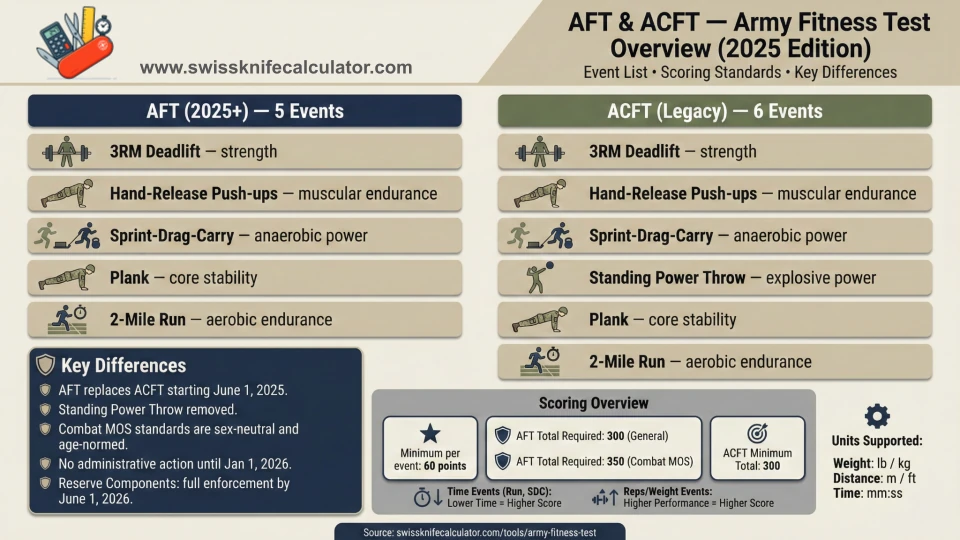
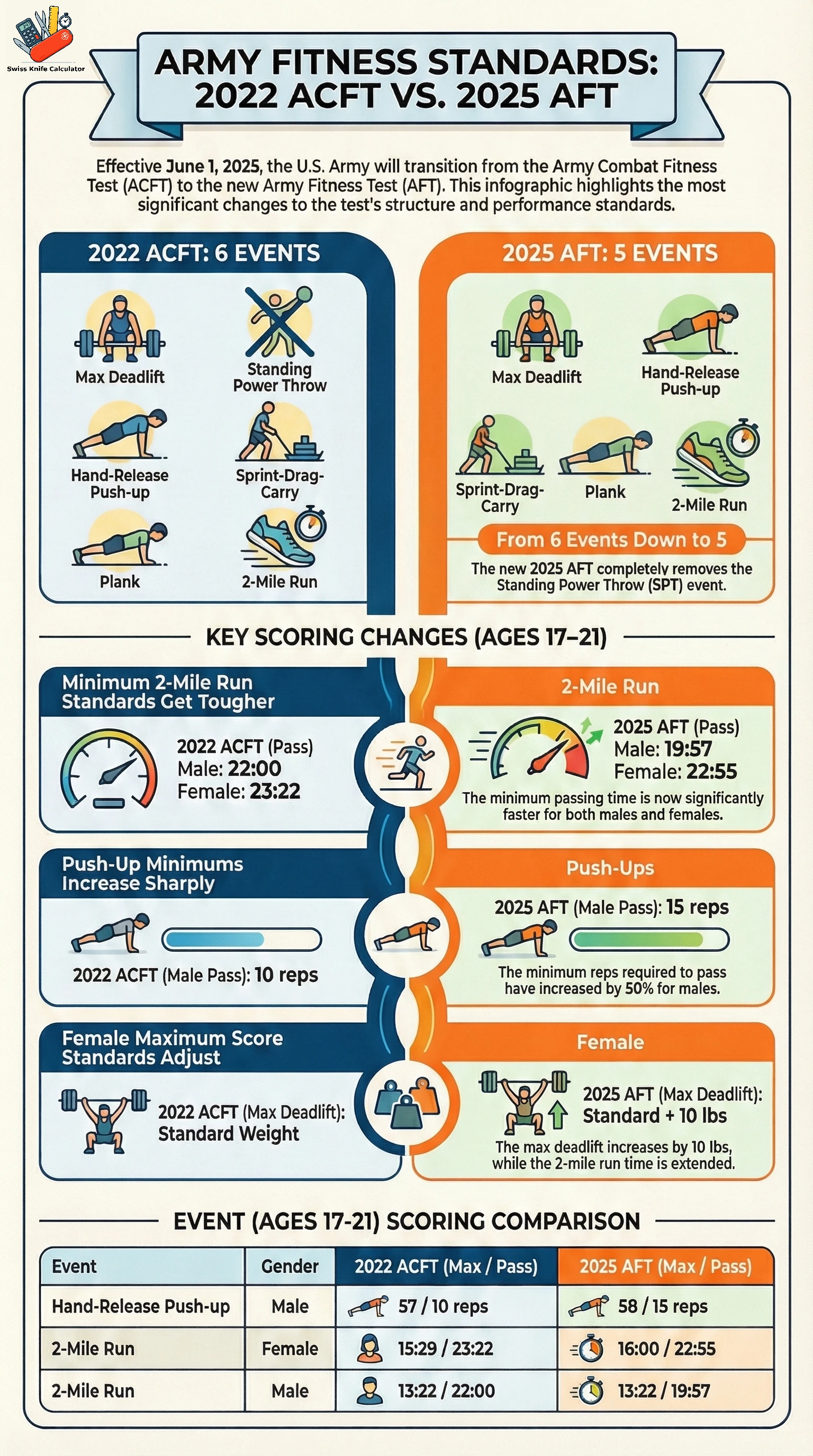
Want the detailed cutoffs? Use the tables section to cross-check your current band.
Use Cases (when this is actually useful)
- “How many seconds do I need?” planning: because points move in steps, you can target the next cutoff instead of guessing a percent improvement.
- Bottleneck detection: the lowest event (in points) is often the fastest way to raise total—unless it risks falling below 60.
- General vs Combat MOS decisions: you can see whether you’re already “safe” for General but still short for Combat MOS totals.
- AFT vs ACFT comparison: switching modes shows how removing SPT changes where your points must come from.
Math/logic tips that save time
- Chase thresholds, not averages: if the next SDC cutoff is 2:06, training to 2:07 is emotionally satisfying but can be worth 0 points.
- Don’t “round down” conversions: converting kg→lb (or m→ft) and then rounding can push a value below a cutoff. If you’re close, enter the measurement in the unit you actually tested.
- Time-entry ambiguity: keep it in
mm:ssso you don’t accidentally plan around the wrong number (e.g.,210is interpreted as2:10).
If you want practice ideas without changing anything on the page layout, use the practice guide section (it’s designed to match the event logic above).
🏠 Train & self-test guide (home / garage / gym)
Use this section to practice the AFT/ACFT events safely, then plug your results into the calculator to see points, pass/fail, and what to improve next. These ideas are for training and self-assessment only — official testing must follow current Army procedures and equipment.
Before you start
- Warm up 8–12 minutes: easy jog/row + dynamic mobility (hips, ankles, shoulders) + 2–3 build-up efforts.
- Measure & time accurately: phone stopwatch or interval app; mark distances with a tape, cones, or chalk; if using a treadmill, set 1% incline to better mimic outdoor effort.
- Safety first: neutral spine for lifts, clear lanes for shuttles, flat surface for throws/runs, and stop if form breaks.
- Use the calculator: after a practice set, enter your best valid attempt; note the next 10-point bracket and make that your short-term target.
3RM Deadlift — practice at home
- What counts: heaviest trap-bar deadlift for 3 controlled reps in one set. Hips/shoulders rise together; full lockout each rep.
- No trap bar? Use a straight bar from blocks, a heavy kettlebell pair, or a loaded trap-handle farmer carry rig. It’s fine for training feedback; official scoring uses the trap bar.
- Build-up sets: 5–6 sets of 3 reps, adding weight each set; rest 2–3 min. Stop the set if your back rounds or speed dies.
- Enter in the tool: record the heaviest successful triple (lb/kg). The calculator maps it to points and shows how many pounds to the next bracket.
Hand-Release Push-ups — standards & practice
- Standards: from a rigid plank, lower chest to the ground, release both hands, then press to full elbow extension. No hips-first “worming.”
- Self-test: 2-minute max. Use a phone camera from the side to audit form and count clean reps.
- Progressions: EMOM (every minute on the minute) 5–10 rounds of 6–12 clean reps, adding 1–2 total reps weekly; tempo sets (3-1-1) to build control.
- Enter in the tool: type total clean reps; the tool shows your points and how many reps to the next band.
Sprint-Drag-Carry — space & substitutions
- Layout: five 50-meter shuttles (sprint → drag → lateral → carry → sprint). If you only have 25 m of space, run 10 x 25 m in the same order. Keep lanes clear and turns safe.
- Drag & carry at home: sled or tire drag with straps; sandbag/duffel carry. Match the feel rather than exact friction/loads for training; official tests use prescribed equipment.
- Timing: one continuous clock. Practice smooth transitions; that’s where many seconds live.
- Enter in the tool: report total time in
mm:ss. Faster times increase points.
Plank — hold quality & progress
- Standards: forearms on ground, elbows under shoulders, heels-hip-shoulder line straight; stop when hips sag/pike or any support leaves the standard.
- Build capacity: 3–5 sets at 60–90% of your current best with 60–90 s rest; add 5–10 s per week total. Mix in side planks and hollow holds.
- Enter in the tool: best valid hold in
mm:ss; the calculator shows your point band and the next target time.
2-Mile Run — pacing & measurement
- Course: measured track/loop or GPS; on a treadmill, use 1% incline and stable foot strike.
- Pacing: break the distance into 4 x 800 m (or 8 x 400 m) splits; aim for even or slight negative splits.
- Progress: one quality session/week (e.g., 6 x 800 m @ goal pace with 2–3 min easy jog), one longer easy run, and one tempo or hills session.
- Enter in the tool: finish time in
mm:ss. The tool highlights how many seconds to the next 10-point bracket.
ACFT-only: Standing Power Throw (SPT)
- Setup: 10 lb medicine ball, throw from a legal stance with both hands overhead and back. Mark distances with a tape or chalk line; measure to the nearest mark.
- Practice: 3–5 sets of 3 throws (build slowly; no rushed spikes). Add hip hinge drills and overhead slams for power.
- Enter in the tool: best valid distance (m/ft) for ACFT scoring.
Use the calculator to plan training
- Find your bottleneck: sort your event cards by points and attack the lowest one first.
- Chase the next bracket: the step tables reward “thresholds.” Aim just past the next 60/70/80/90/100 step for the fastest gains.
- Track progress: use Copy for a quick log entry, Export CSV for spreadsheets, or Print / Save as PDF for counseling notes.
- Simulate goals: type your target numbers to see if you clear General (≥300) or Combat MOS (≥350) and which event limits you.
Minimal gear checklist
- Trap bar (or straight bar + blocks / heavy kettlebells), collars, and flat plates.
- 10 lb medicine ball (for ACFT SPT practice).
- Drag implement (sled/tire + strap) and a carry object (sandbag/duffel/kettlebells).
- Measuring tape, 4–6 cones/chalk, stopwatch/phone, and a safe flat surface.
Note: Training substitutes are great for practice feedback but may not match official conditions exactly. For record testing, follow the equipment and procedures in current Army publications.
📊 AFT (2025+) — tables at a glance (tap to expand)
AFT (2025+)
3RM Deadlift (lb)
| Age band / Sex | 60 | 70 | 80 | 90 | 100 |
|---|---|---|---|---|---|
| 17-21 • M | 150 | 200 | 250 | 300 | 340 |
| 17-21 • F | 120 | 140 | 150 | 180 | 220 |
| 22-26 • M | 150 | 190 | 250 | 300 | 350 |
| 22-26 • F | 120 | 140 | 160 | 190 | 230 |
| 27-31 • M | 150 | 190 | 250 | 300 | 350 |
| 27-31 • F | 120 | 140 | 160 | 190 | 240 |
| 32-36 • M | 140 | 190 | 250 | 300 | 350 |
| 32-36 • F | 120 | 140 | 160 | 180 | 230 |
| 37-41 • M | 140 | 190 | 250 | 300 | 350 |
| 37-41 • F | 120 | 140 | 150 | 180 | 220 |
| 42-46 • M | 140 | 190 | 250 | 290 | 350 |
| 42-46 • F | 120 | 130 | 150 | 170 | 210 |
| 47-51 • M | 140 | 190 | 240 | 290 | 340 |
| 47-51 • F | 120 | 130 | 150 | 170 | 200 |
| 52-56 • M | 140 | 180 | 230 | 280 | 330 |
| 52-56 • F | 120 | 130 | 150 | 160 | 190 |
| 57-61 • M | 140 | 150 | 170 | 180 | 250 |
| 57-61 • F | 120 | 130 | 140 | 150 | 170 |
| 62+ • M | 140 | 150 | 160 | 170 | 230 |
| 62+ • F | 120 | 130 | 140 | 150 | 170 |
Hand-Release Push-ups (reps)
| Age band / Sex | 60 | 70 | 80 | 90 | 100 |
|---|---|---|---|---|---|
| 17-21 • M | 15 | 28 | 37 | 46 | 58 |
| 17-21 • F | 11 | 18 | 23 | 32 | 53 |
| 22-26 • M | 14 | 26 | 37 | 48 | 61 |
| 22-26 • F | 11 | 16 | 23 | 33 | 50 |
| 27-31 • M | 14 | 26 | 37 | 48 | 62 |
| 27-31 • F | 11 | 16 | 23 | 33 | 48 |
| 32-36 • M | 13 | 26 | 36 | 47 | 60 |
| 32-36 • F | 11 | 16 | 23 | 32 | 47 |
| 37-41 • M | 12 | 24 | 35 | 46 | 59 |
| 37-41 • F | 10 | 16 | 22 | 30 | 43 |
| 42-46 • M | 11 | 23 | 34 | 44 | 57 |
| 42-46 • F | 10 | 15 | 21 | 29 | 40 |
| 47-51 • M | 11 | 22 | 32 | 42 | 55 |
| 47-51 • F | 10 | 15 | 20 | 28 | 38 |
| 52-56 • M | 10 | 21 | 30 | 40 | 51 |
| 52-56 • F | 10 | 14 | 19 | 26 | 36 |
| 57-61 • M | 10 | 13 | 18 | 29 | 46 |
| 57-61 • F | 10 | 12 | 13 | 15 | 24 |
| 62+ • M | 10 | 12 | 17 | 26 | 43 |
| 62+ • F | 10 | 12 | 13 | 15 | 24 |
Sprint-Drag-Carry (mm:ss)
| Age band / Sex | 60 | 70 | 80 | 90 | 100 |
|---|---|---|---|---|---|
| 17-21 • M | 2:28 | 2:03 | 1:53 | 1:43 | 1:29 |
| 17-21 • F | 3:15 | 2:41 | 2:28 | 2:16 | 1:55 |
| 22-26 • M | 2:31 | 2:05 | 1:53 | 1:43 | 1:30 |
| 22-26 • F | 3:15 | 2:43 | 2:29 | 2:15 | 1:55 |
| 27-31 • M | 2:32 | 2:06 | 1:55 | 1:45 | 1:30 |
| 27-31 • F | 3:15 | 2:43 | 2:29 | 2:16 | 1:55 |
| 32-36 • M | 2:36 | 2:10 | 1:58 | 1:48 | 1:33 |
| 32-36 • F | 3:22 | 2:47 | 2:34 | 2:20 | 1:59 |
| 37-41 • M | 2:41 | 2:14 | 2:02 | 1:52 | 1:36 |
| 37-41 • F | 3:27 | 2:52 | 2:38 | 2:25 | 2:02 |
| 42-46 • M | 2:45 | 2:20 | 2:07 | 1:56 | 1:40 |
| 42-46 • F | 3:42 | 2:58 | 2:44 | 2:30 | 2:09 |
| 47-51 • M | 2:53 | 2:27 | 2:14 | 2:02 | 1:45 |
| 47-51 • F | 3:51 | 3:05 | 2:50 | 2:37 | 2:11 |
| 52-56 • M | 3:00 | 2:35 | 2:23 | 2:10 | 1:52 |
| 52-56 • F | 4:03 | 3:19 | 2:58 | 2:44 | 2:18 |
| 57-61 • M | 3:12 | 2:43 | 2:29 | 2:17 | 1:58 |
| 57-61 • F | 4:48 | 3:36 | 3:07 | 2:54 | 2:26 |
| 62+ • M | 3:16 | 2:49 | 2:32 | 2:16 | 2:09 |
| 62+ • F | 4:48 | 3:36 | 3:07 | 2:54 | 2:26 |
Plank (mm:ss)
| Age band / Sex | 60 | 70 | 80 | 90 | 100 |
|---|---|---|---|---|---|
| 17-21 • M | 1:30 | 2:02 | 2:35 | 3:08 | 3:40 |
| 17-21 • F | 1:30 | 2:02 | 2:35 | 3:08 | 3:40 |
| 22-26 • M | 1:25 | 1:58 | 2:30 | 3:03 | 3:35 |
| 22-26 • F | 1:25 | 1:58 | 2:30 | 3:03 | 3:35 |
| 27-31 • M | 1:20 | 1:52 | 2:25 | 2:58 | 3:30 |
| 27-31 • F | 1:20 | 1:52 | 2:25 | 2:58 | 3:30 |
| 32-36 • M | 1:15 | 1:47 | 2:20 | 2:53 | 3:25 |
| 32-36 • F | 1:15 | 1:47 | 2:20 | 2:53 | 3:25 |
| 37-41 • M | 1:10 | 1:42 | 2:15 | 2:47 | 3:20 |
| 37-41 • F | 1:10 | 1:42 | 2:15 | 2:47 | 3:20 |
| 42-46 • M | 1:10 | 1:42 | 2:15 | 2:47 | 3:20 |
| 42-46 • F | 1:10 | 1:42 | 2:15 | 2:47 | 3:20 |
| 47-51 • M | 1:10 | 1:42 | 2:15 | 2:47 | 3:20 |
| 47-51 • F | 1:10 | 1:42 | 2:15 | 2:47 | 3:20 |
| 52-56 • M | 1:10 | 1:42 | 2:15 | 2:47 | 3:20 |
| 52-56 • F | 1:10 | 1:42 | 2:15 | 2:47 | 3:20 |
| 57-61 • M | 1:10 | 1:42 | 2:15 | 2:47 | 3:20 |
| 57-61 • F | 1:10 | 1:42 | 2:15 | 2:47 | 3:20 |
| 62+ • M | 1:10 | 1:42 | 2:15 | 2:47 | 3:20 |
| 62+ • F | 1:10 | 1:42 | 2:15 | 2:47 | 3:20 |
2-Mile Run (mm:ss)
| Age band / Sex | 60 | 70 | 80 | 90 | 100 |
|---|---|---|---|---|---|
| 17-21 • M | 19:57 | 18:35 | 17:13 | 15:39 | 13:22 |
| 17-21 • F | 22:55 | 21:06 | 19:30 | 17:55 | 16:00 |
| 22-26 • M | 19:45 | 18:23 | 17:08 | 15:38 | 13:25 |
| 22-26 • F | 22:45 | 21:00 | 19:25 | 17:44 | 15:30 |
| 27-31 • M | 19:45 | 18:23 | 17:21 | 15:38 | 13:25 |
| 27-31 • F | 22:45 | 21:00 | 19:45 | 17:44 | 15:30 |
| 32-36 • M | 20:44 | 18:30 | 17:16 | 15:50 | 13:42 |
| 32-36 • F | 22:50 | 21:13 | 19:53 | 18:21 | 15:48 |
| 37-41 • M | 20:44 | 18:35 | 17:33 | 16:01 | 13:42 |
| 37-41 • F | 22:59 | 21:16 | 19:57 | 18:25 | 15:51 |
| 42-46 • M | 22:04 | 18:55 | 17:47 | 16:15 | 14:05 |
| 42-46 • F | 23:15 | 21:30 | 20:10 | 18:37 | 16:00 |
| 47-51 • M | 22:04 | 19:30 | 18:12 | 16:39 | 14:30 |
| 47-51 • F | 23:30 | 21:45 | 20:34 | 19:03 | 16:30 |
| 52-56 • M | 22:50 | 20:20 | 19:00 | 17:26 | 15:09 |
| 52-56 • F | 24:00 | 22:38 | 21:19 | 19:47 | 16:59 |
| 57-61 • M | 23:36 | 21:00 | 19:45 | 18:17 | 15:28 |
| 57-61 • F | 24:48 | 23:11 | 21:51 | 20:26 | 17:18 |
| 62+ • M | 23:36 | 21:00 | 19:45 | 18:17 | 15:28 |
| 62+ • F | 25:00 | 23:20 | 21:59 | 20:26 | 17:18 |
Standards — General: ≥60/event & ≥300 total. Combat MOS: ≥60/event & ≥350 total.
📊 ACFT (Legacy 2022) — tables at a glance (tap to expand)
ACFT (Legacy 2022)
3RM Deadlift (lb)
| Age band / Sex | 60 | 70 | 80 | 90 | 100 |
|---|---|---|---|---|---|
| 17-21 • M | 140 | 200 | 240 | 280 | 340 |
| 17-21 • F | 120 | 140 | 160 | 170 | 210 |
| 22-26 • M | 140 | 190 | 250 | 310 | 340 |
| 22-26 • F | 120 | 140 | 160 | 180 | 230 |
| 27-31 • M | 140 | 190 | 250 | 310 | 340 |
| 27-31 • F | 120 | 140 | 160 | 180 | 230 |
| 32-36 • M | 140 | 180 | 240 | 300 | 340 |
| 32-36 • F | 120 | 140 | 160 | 170 | 230 |
| 37-41 • M | 140 | 160 | 220 | 270 | 340 |
| 37-41 • F | 120 | 140 | 160 | 160 | 210 |
| 42-46 • M | 140 | 160 | 210 | 260 | 340 |
| 42-46 • F | 120 | 140 | 160 | 160 | 210 |
| 47-51 • M | 140 | 150 | 170 | 230 | 330 |
| 47-51 • F | 120 | 140 | 160 | 160 | 190 |
| 52-56 • M | 140 | 150 | 170 | 210 | 290 |
| 52-56 • F | 120 | 130 | 140 | 150 | 190 |
| 57-61 • M | 140 | 150 | 170 | 180 | 250 |
| 57-61 • F | 120 | 130 | 140 | 150 | 170 |
| 62+ • M | 140 | 150 | 160 | 170 | 230 |
| 62+ • F | 120 | 130 | 140 | 150 | 170 |
Standing Power Throw (m)
| Age band / Sex | 60 | 70 | 80 | 90 | 100 |
|---|---|---|---|---|---|
| 17-21 • M | 6 | 8.2 | 9.3 | 10.5 | 12.6 |
| 17-21 • F | 3.9 | 5.2 | 5.8 | 6.5 | 8.4 |
| 22-26 • M | 6.3 | 8.6 | 9.7 | 11 | 13 |
| 22-26 • F | 4 | 5.3 | 5.9 | 6.8 | 8.5 |
| 27-31 • M | 6.5 | 8.8 | 9.8 | 11.1 | 13.1 |
| 27-31 • F | 4.2 | 5.3 | 6.1 | 6.9 | 8.7 |
| 32-36 • M | 6.5 | 8.7 | 9.8 | 11 | 12.9 |
| 32-36 • F | 4.1 | 5.3 | 5.9 | 6.8 | 8.6 |
| 37-41 • M | 6.4 | 8.6 | 9.6 | 10.7 | 12.8 |
| 37-41 • F | 4.1 | 5.2 | 5.7 | 6.4 | 8.2 |
| 42-46 • M | 6.2 | 8.2 | 9.2 | 10.4 | 12.3 |
| 42-46 • F | 3.9 | 5.1 | 5.7 | 6.4 | 8.1 |
| 47-51 • M | 6 | 7.9 | 8.7 | 9.7 | 11.6 |
| 47-51 • F | 3.7 | 4.9 | 5.3 | 6 | 7.8 |
| 52-56 • M | 5.7 | 7.3 | 8.1 | 9 | 10.6 |
| 52-56 • F | 3.5 | 4.6 | 5.2 | 5.7 | 7.4 |
| 57-61 • M | 5.3 | 6.9 | 7.7 | 8.5 | 9.9 |
| 57-61 • F | 3.4 | 4.6 | 5.1 | 5.5 | 6.6 |
| 62+ • M | 4.9 | 6.6 | 7.5 | 8 | 9 |
| 62+ • F | 3.4 | 4.6 | 5.1 | 5.5 | 6.6 |
Hand-Release Push-ups (reps)
| Age band / Sex | 60 | 70 | 80 | 90 | 100 |
|---|---|---|---|---|---|
| 17-21 • M | 10 | 28 | 37 | 45 | 57 |
| 17-21 • F | 10 | 18 | 27 | 36 | 53 |
| 22-26 • M | 10 | 25 | 35 | 46 | 61 |
| 22-26 • F | 10 | 15 | 24 | 33 | 50 |
| 27-31 • M | 10 | 23 | 35 | 46 | 62 |
| 27-31 • F | 10 | 14 | 21 | 30 | 48 |
| 32-36 • M | 10 | 22 | 33 | 44 | 60 |
| 32-36 • F | 10 | 13 | 19 | 30 | 47 |
| 37-41 • M | 10 | 20 | 30 | 42 | 59 |
| 37-41 • F | 10 | 12 | 16 | 22 | 41 |
| 42-46 • M | 10 | 18 | 28 | 38 | 56 |
| 42-46 • F | 10 | 12 | 14 | 20 | 36 |
| 47-51 • M | 10 | 15 | 23 | 34 | 55 |
| 47-51 • F | 10 | 12 | 13 | 20 | 35 |
| 52-56 • M | 10 | 14 | 21 | 31 | 51 |
| 52-56 • F | 10 | 12 | 13 | 17 | 30 |
| 57-61 • M | 10 | 13 | 18 | 29 | 46 |
| 57-61 • F | 10 | 12 | 13 | 15 | 24 |
| 62+ • M | 10 | 12 | 17 | 26 | 43 |
| 62+ • F | 10 | 12 | 13 | 15 | 24 |
Sprint-Drag-Carry (mm:ss)
| Age band / Sex | 60 | 70 | 80 | 90 | 100 |
|---|---|---|---|---|---|
| 17-21 • M | 2:28 | 2:03 | 1:53 | 1:43 | 1:29 |
| 17-21 • F | 3:15 | 2:41 | 2:28 | 2:16 | 1:55 |
| 22-26 • M | 2:31 | 2:05 | 1:53 | 1:43 | 1:30 |
| 22-26 • F | 3:15 | 2:43 | 2:29 | 2:15 | 1:55 |
| 27-31 • M | 2:32 | 2:06 | 1:55 | 1:45 | 1:30 |
| 27-31 • F | 3:15 | 2:43 | 2:29 | 2:16 | 1:55 |
| 32-36 • M | 2:36 | 2:10 | 1:58 | 1:48 | 1:33 |
| 32-36 • F | 3:22 | 2:47 | 2:34 | 2:20 | 1:59 |
| 37-41 • M | 2:41 | 2:14 | 2:02 | 1:52 | 1:36 |
| 37-41 • F | 3:27 | 2:52 | 2:38 | 2:25 | 2:02 |
| 42-46 • M | 2:45 | 2:20 | 2:07 | 1:56 | 1:40 |
| 42-46 • F | 3:42 | 2:58 | 2:44 | 2:30 | 2:09 |
| 47-51 • M | 2:53 | 2:27 | 2:14 | 2:02 | 1:45 |
| 47-51 • F | 3:51 | 3:05 | 2:50 | 2:37 | 2:11 |
| 52-56 • M | 3:00 | 2:35 | 2:23 | 2:10 | 1:52 |
| 52-56 • F | 4:03 | 3:19 | 2:58 | 2:44 | 2:18 |
| 57-61 • M | 3:12 | 2:43 | 2:29 | 2:17 | 1:58 |
| 57-61 • F | 4:48 | 3:36 | 3:07 | 2:54 | 2:26 |
| 62+ • M | 3:16 | 2:49 | 2:32 | 2:16 | 2:09 |
| 62+ • F | 4:48 | 3:36 | 3:07 | 2:54 | 2:26 |
Plank (mm:ss)
| Age band / Sex | 60 | 70 | 80 | 90 | 100 |
|---|---|---|---|---|---|
| 17-21 • M | 1:30 | 2:02 | 2:35 | 3:08 | 3:40 |
| 17-21 • F | 1:30 | 2:02 | 2:35 | 3:08 | 3:40 |
| 22-26 • M | 1:25 | 1:58 | 2:30 | 3:03 | 3:35 |
| 22-26 • F | 1:25 | 1:58 | 2:30 | 3:03 | 3:35 |
| 27-31 • M | 1:20 | 1:52 | 2:25 | 2:58 | 3:30 |
| 27-31 • F | 1:20 | 1:52 | 2:25 | 2:58 | 3:30 |
| 32-36 • M | 1:15 | 1:47 | 2:20 | 2:53 | 3:25 |
| 32-36 • F | 1:15 | 1:47 | 2:20 | 2:53 | 3:25 |
| 37-41 • M | 1:10 | 1:42 | 2:15 | 2:47 | 3:20 |
| 37-41 • F | 1:10 | 1:42 | 2:15 | 2:47 | 3:20 |
| 42-46 • M | 1:10 | 1:42 | 2:15 | 2:47 | 3:20 |
| 42-46 • F | 1:10 | 1:42 | 2:15 | 2:47 | 3:20 |
| 47-51 • M | 1:10 | 1:42 | 2:15 | 2:47 | 3:20 |
| 47-51 • F | 1:10 | 1:42 | 2:15 | 2:47 | 3:20 |
| 52-56 • M | 1:10 | 1:42 | 2:15 | 2:47 | 3:20 |
| 52-56 • F | 1:10 | 1:42 | 2:15 | 2:47 | 3:20 |
| 57-61 • M | 1:10 | 1:42 | 2:15 | 2:47 | 3:20 |
| 57-61 • F | 1:10 | 1:42 | 2:15 | 2:47 | 3:20 |
| 62+ • M | 1:10 | 1:42 | 2:15 | 2:47 | 3:20 |
| 62+ • F | 1:10 | 1:42 | 2:15 | 2:47 | 3:20 |
2-Mile Run (mm:ss)
| Age band / Sex | 60 | 70 | 80 | 90 | 100 |
|---|---|---|---|---|---|
| 17-21 • M | 22:00 | 18:35 | 16:57 | 15:30 | 13:22 |
| 17-21 • F | 23:22 | 20:40 | 19:17 | 17:56 | 15:29 |
| 22-26 • M | 22:00 | 18:50 | 17:13 | 15:43 | 13:27 |
| 22-26 • F | 23:15 | 20:32 | 19:03 | 17:37 | 15:00 |
| 27-31 • M | 22:00 | 18:46 | 17:14 | 15:48 | 13:31 |
| 27-31 • F | 23:13 | 20:25 | 19:00 | 17:35 | 15:00 |
| 32-36 • M | 22:00 | 18:53 | 17:23 | 15:58 | 13:42 |
| 32-36 • F | 23:19 | 20:35 | 19:15 | 17:50 | 15:18 |
| 37-41 • M | 22:11 | 19:06 | 17:38 | 16:10 | 13:58 |
| 37-41 • F | 23:23 | 20:46 | 19:22 | 18:00 | 15:30 |
| 42-46 • M | 22:32 | 19:26 | 17:55 | 16:28 | 14:05 |
| 42-46 • F | 23:42 | 21:00 | 19:45 | 18:16 | 15:49 |
| 47-51 • M | 22:55 | 19:57 | 18:26 | 16:57 | 14:30 |
| 47-51 • F | 24:00 | 21:09 | 19:52 | 18:24 | 15:58 |
| 52-56 • M | 23:20 | 20:27 | 19:03 | 17:36 | 15:09 |
| 52-56 • F | 24:24 | 21:40 | 20:22 | 18:53 | 16:29 |
| 57-61 • M | 23:36 | 21:00 | 19:45 | 18:17 | 15:28 |
| 57-61 • F | 24:48 | 21:40 | 20:22 | 18:59 | 17:18 |
| 62+ • M | 23:36 | 21:00 | 19:45 | 18:17 | 15:28 |
| 62+ • F | 25:00 | 21:40 | 20:22 | 18:59 | 17:18 |
Standards — General: ≥60/event & ≥300 total.
Frequently Asked Questions
What is the minimum passing score for AFT (General vs Combat MOS)?
General requires at least 60 points on each event and 300 points total; Combat MOS requires at least 60 on each event and 350 total (sex-neutral pass line, age-banded tables).
Why can I have 300+ total points and still fail?
Because AFT passing is per-event: any event below 60 points is an automatic fail, even if your total exceeds the minimum.
How does the score turn raw results into points?
Each event uses a step table: higher-is-better events award the highest point row where your result meets or exceeds the threshold, and timed events award the highest row where your time is at or under the threshold.
For the 3RM deadlift, should I enter total weight or per-side plates?
Enter the total load you lifted for three clean reps (trap-bar plus plates), not the weight on one side and not a 1-rep max estimate.
What time format should I use for SDC, plank, and the 2-mile run?
Use mm:ss (for example 14:30). If you type 1430 it will be treated as 14:30, and 210 will be treated as 2:10.
Do age band and sex change the point tables?
Yes—your points depend on the selected age band, and tables may differ by sex where defined; the Combat MOS pass requirement is sex-neutral but still uses age bands.
Why didn’t my points change after a small improvement?
Points only change when you cross the next threshold row in the step table, so a small time drop or a few extra pounds may be worth 0 points until it reaches the next cutoff.
Which events are “higher is better” vs “lower is better”?
Higher-is-better: 3RM deadlift, hand-release push-ups, plank (and Standing Power Throw in ACFT). Lower-is-better: sprint-drag-carry and the 2-mile run.
Does ACFT scoring still include the Standing Power Throw?
Yes—Standing Power Throw is scored in ACFT (Legacy) mode only; AFT (2025+) uses five events and removes SPT.
How should I handle unit conversions (lb/kg and m/ft) when planning?
Use one unit system consistently for training logs; the calculator converts to the table units for scoring, but rounding your own conversions can push you just below a cutoff.
Are alternate aerobic events included here?
No—alternate aerobic events and GO/NO-GO policies vary by regulation and component; this page focuses on the standard 2-mile run tables shown on the page.
Is this an official Army resource or medical advice?
No—this is an educational planning tool; verify current policy with official publications and your chain of command, and consult a qualified professional for training or health concerns.
Assumptions, Limits & Disclaimer
- Tables and policy can change: the page reflects the table-based scoring shown here for AFT (2025+) and ACFT (Legacy). If your unit publishes updated cutoffs or enforcement rules, follow those.
- Administration details vary: equipment setup, lane layout, and validation rules (especially for SDC and SPT) may differ by SOP even when the scoring table is the same.
- Close-to-cutoff measurements: timing precision, distance markings, and rounding can shift you across a threshold. If you are near a cutoff, plan with a buffer instead of “exactly equal.”
Disclaimer: Educational planning only. Not an official U.S. Army website and not medical advice. No guarantees are provided; always verify current standards with official publications and your chain of command.
Back to top: SwissKnifeCalculator home • Health & Fitness hub
📚 References
- Army public releases and scoring scale publications (AFT/ACFT).
- Service guidance for MOS-specific standards and phased enforcement timelines.
- Army.mil — Army Fitness Test hub
- Army.mil — AFT announcement (Apr 2025)
- ACFT Scoring Scales (Mar 2022 PDF)
- AFT Scoring Scales (Jun 2025 PDF)